
Read Huntington Property Tax Records
Tax records in Huntington County stitch together assessment roll fields and Treasurer billing data. That blend is useful, but it has a catch. Read the year beside every figure you see. Annual trending, a deduction, a parcel split, or a posted payment can make two screens disagree without either being wrong about its own point in time.
| Field | What It Shows | Where |
|---|---|---|
| Land and improvement values | Components behind assessed value | Assessor / Beacon |
| Owner, situs, and mailing lines | Roll name and two different address roles | Auditor / Beacon |
| Deductions | Adjustments applied before the taxable amount | Auditor |
| Bill and payment status | Installments, amounts, and delinquency | Treasurer |
| Tax district and year | The jurisdictional and time context | Tax list |
Indiana measures property under a market-value-in-use framework at a one hundred percent ratio. Annual trending keeps values moving between reassessments. The tax bill then layers rates and deductions onto taxable value. A deed's consideration is a different number entirely. It may not match market value.
Three Huntington Tax Offices
Assessor Jill E. Amick-Zorger measures, classifies, and values property across Huntington County. Auditor Jill M. Landrum keeps the tax roll and its deductions. Treasurer Brenda S. Hamilton handles billing, payments, delinquency, and tax-sale administration, and all three offices sit at 201 N Jefferson Street in Huntington.
Beacon brings parcel, map, and assessment information into one place. The Treasurer and Auditor each run separate public tax lists. A title question goes to the Recorder instead.
Note: Give the office the PIN and tax year when asking them to reconcile screens, since one owner name can match several parcels.
Huntington Tax List Search
The Treasurer tax list takes a district, parcel number, name, tax year, or property address. Enter too much at once, though, and you can choke off results. The screen itself advises that a recently split or combined parcel is easiest to find under the owner's last name.
| Field | Use | Watch for |
|---|---|---|
| District | Narrow the tax jurisdiction | Mailing city may differ |
| Parcel number | Exact current parcel | Inactive predecessor |
| Name | Find several owned parcels | Trust or entity style |
| Tax year | Choose the billing cycle | Do not mix years |
| Property address | Find a known site | Rural fragments |
The public Auditor mirror can help with inactive parcels. No list, though, replaces a current balance quote straight from the Treasurer.
Huntington Assessed Value Lines
A Beacon card can display land, improvements, value history, and a Form 11 link. Some modules stay empty. The sample vacant parcel carried land and soil rows. The dwelling, improvement, photo, sketch, and deduction modules sat blank. An empty module proves nothing about the fact behind it.
The DLGF assessed-value resource stresses total land and improvements. Match that total against the right assessment year, parcel class, acreage, and neighborhood. Then lean on it in an appeal.
- Assessed value
- The value used in Indiana's tax system.
- Market value-in-use
- The state framework for property devoted to its current use.
- Deduction
- A statutory reduction applied through the Auditor.
- Tax lien
- A claim arising from unpaid tax, not the same as the bill itself.
Look Up a Huntington Tax Bill
Start with the PIN whenever you can. Same-name owners and vague rural addresses cause far more confusion. If a split changed the PIN, search the last name and compare acreage, situs, and district to land on the right parcel.
- Open the Treasurer list and enter the parcel, name, or property address.
- Select the intended tax year and confirm the tax district.
- Compare the bill with Beacon and the Auditor's deduction information.
- Contact the Treasurer for a current payoff, correction, delinquency, or sale question.
- Taxable value
- The value left after applicable deductions.
- Tax rate or levy
- The rate applied for the relevant districts.
- Homestead deduction
- Owner-occupied relief that must be supported and approved.
- Delinquency
- An unpaid amount subject to the county's collection process.
An online duplicate statement can go stale after a payment or correction. Save the search date, then have the Treasurer confirm the live ledger before any purchase or payoff.
Huntington's 2026 Reassessment Cycle
Indiana's statewide cyclical reassessment starts July 1, 2026 for taxes paid in 2027. Under the DLGF schedule, the work runs across four years. Roughly a quarter of parcels get a physical review each year.
Huntington County owners should watch for assessment notices during that cycle. They should also check the physical facts. Fixing acreage, classification, or improvement data is a different task from arguing judgment calls. Keep dated photos, measurements, comparable sales, and the parcel card that raised the concern.
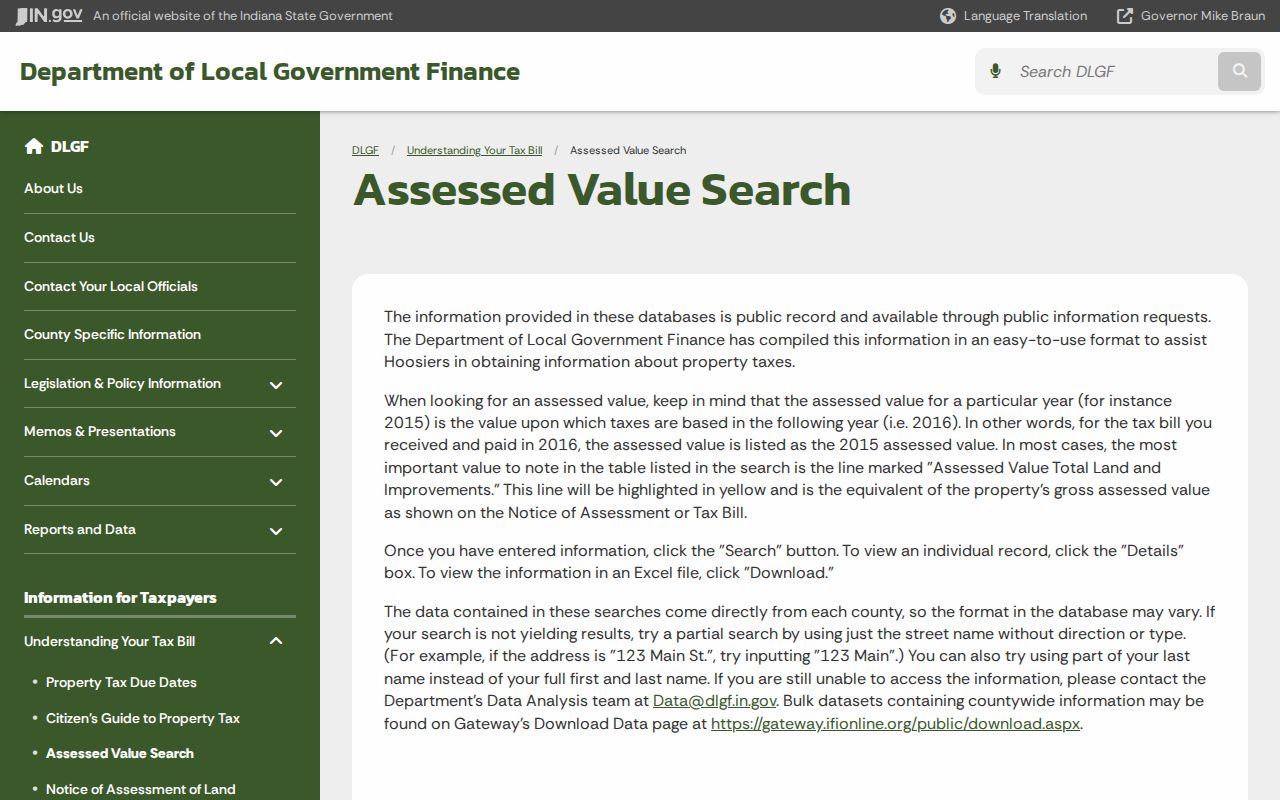
The state page helps separate assessed land and improvement totals from the amount eventually billed.
Huntington Delinquent Property Tax
Delinquency and tax sales belong to the Treasurer. A 2024 county notice described a September 17 sale. Treat that date as history rather than a current fact. Every year brings a new notice, list, deadlines, and certified-funds rules worth checking fresh.
Use the tax list to spot a possible balance. Then ask the Treasurer for current status. Court and recorder searches can surface liens or deeds. But neither replaces the Treasurer's live figure.
Check Huntington Tax Deductions
Deductions reach the roll through the Auditor. A blank Beacon deduction module settles nothing about eligibility, filing, or what is currently applied. Confirm those points with the Auditor directly.
Keep assessed value, deductions, taxable value, and the bill distinct in your notes. A mailing address alone will not tell you whether an owner occupies the property.
Verify Huntington Tax Statement Dates
A duplicate statement is a snapshot, not the live ledger. Huntington County's own material warns that it does not update after payments or corrections. Write down the year and your search date, then call the Treasurer.
After a split, the inactive predecessor may linger on screen. The successor carries the balance. Search by last name and compare acreage and legal descriptions before trusting either record.
Request Huntington Tax Records
Start with the right office. The Assessor handles parcel characteristics, classification, trending, and assessed value. The Auditor manages deductions and maintains the tax roll. Billing, payment, delinquency, and tax-sale questions belong to the Treasurer. Have the parcel number ready. Add the tax year, owner of record, situs address, and the exact record you want.
Indiana's APRA gives the public the right to inspect Huntington County records during regular hours. Statutory limits apply. Copies may carry an authorized office fee or actual cost. Electronic copies are often available. An estimate up front avoids surprises. The law reaches existing records only. It does not require the county to produce a new tax analysis.
A mailing address never settles a district question. Rural land can carry a town mailing name while sitting well outside that town's limits. Compare the district field in Beacon against the Treasurer's control record. The sample parcel pairs a remote mailing address with Jefferson Township. An assignment can look wrong. Confirm it with the Auditor rather than trusting a ZIP code.
Appeal a Huntington Assessment
Indiana appeals begin with Form 130 filed at the county level. The general window runs to June 15 of the assessment year. Or it runs 45 days after a notice, whichever applies. Always confirm the deadline printed on your current Form 11 and the DLGF instructions. The path starts with local review. It can move to the Property Tax Assessment Board of Appeals, then to the Indiana Board of Tax Review. Objective errors, such as wrong dimensions, differ from valuation disputes. Both demand parcel-specific evidence. The DLGF appeals page posts the current route.
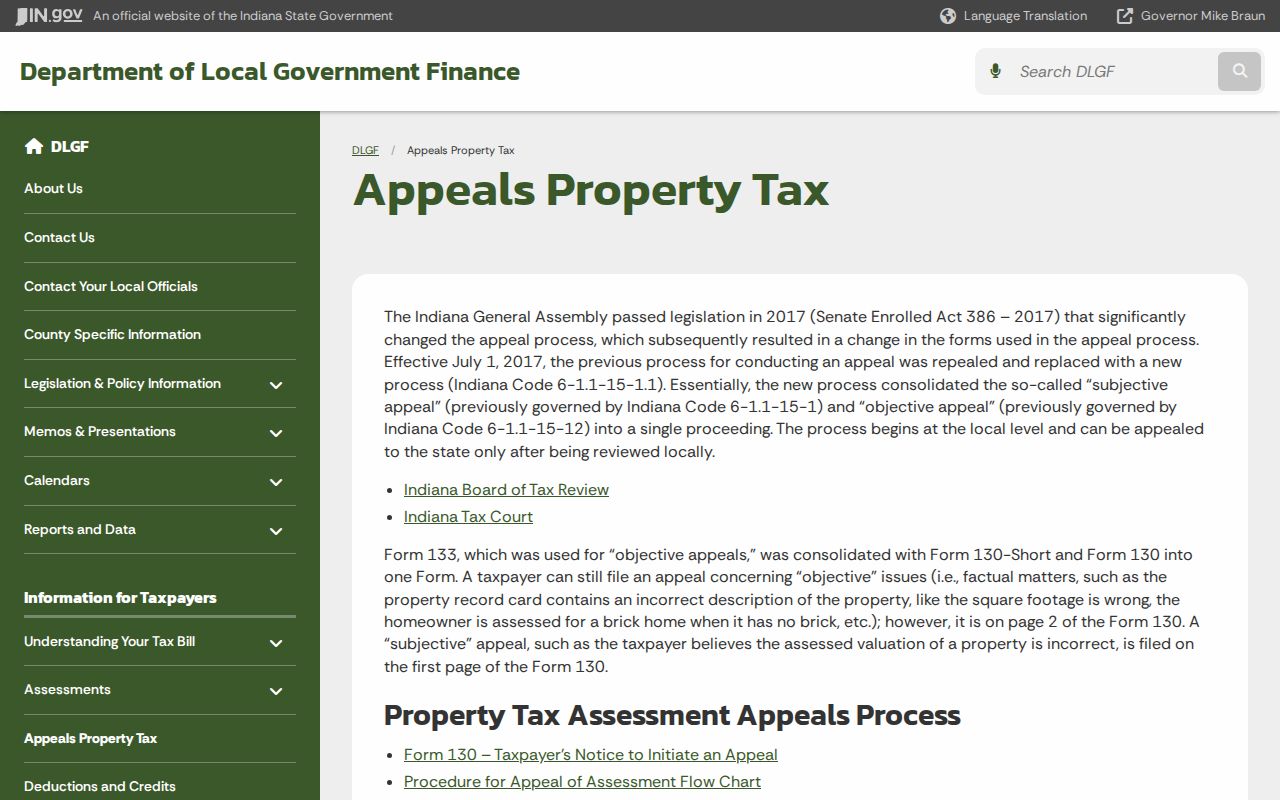
The state appeal screen verifies the Form 130 and local-review steps required before any state-board hearing.
Appeal window. File Form 130 by the deadline that applies to the notice and year. A missed date can end review for that cycle.
Build Huntington Tax Appeal Evidence
Build your evidence around one parcel and one assessment year. Beacon can yield acreage, class, neighborhood, legal description, land details, improvements, and value history. That applies when those modules are populated. Set those facts beside dated photos, your own measurements, and comparable sales. A blank module is not proof that data is missing. Raise it with the Assessor instead.
Keep copies of Form 11, the online card, and the date you pulled each one. Recent splits or combinations need both predecessor and successor parcel numbers. Remember what each office can and cannot do. The Treasurer's payment screen cannot settle value. A Recorder deed alone cannot fix an assessment.
PTABOA is the county-board stage after local review. A further challenge can reach the Indiana Board of Tax Review. Follow the current DLGF filing, evidence, and service instructions rather than an older deadline.