
Deed Types Recorded in Huntington
Every conveyance recorded in Huntington County builds a readable land trail. A deed names the parties. It lists the recording date, a document reference, and a description of the land. It may state consideration as well. That figure does not always equal an open-market sale price. Mortgages and liens work differently. They are encumbrances rather than ownership transfers, so they sit beside deeds in the records without doing the same job.
| Deed Type | What It Does | Common Use |
|---|---|---|
| Warranty deed | Conveys the grantor's interest with title promises stated in the instrument | Ordinary purchase and sale |
| Quitclaim deed | Conveys only the interest the grantor has, if any | Family transfer or title cleanup |
| Trustee or executor deed | Transfers land through a trust or estate representative | Trust and probate administration |
| Sheriff's deed | Documents a conveyance following a court process | Foreclosure-related transfer |
| Tax deed | Records a transfer after the tax-sale process | Delinquent-tax property |
The Recorder also takes in assignments, releases, powers of attorney, contracts, surveys, plats, UCC filings, and miscellaneous instruments. Search these document families together when the goal is due diligence. A purchase deed may be followed by a mortgage, an assignment, and eventually a release. An easement or restrictive covenant can still matter. It may shape the land long after the owner of record changes.
Huntington Deed Search Fields
The Recorder's remote-records page points occasional users to Tapestry and recurring county users to Laredo. Tapestry runs around the clock on a pay-as-you-go basis. The county publishes no first online year, so absence from the remote index should lead to the courthouse or older books, not to a conclusion that no deed exists.
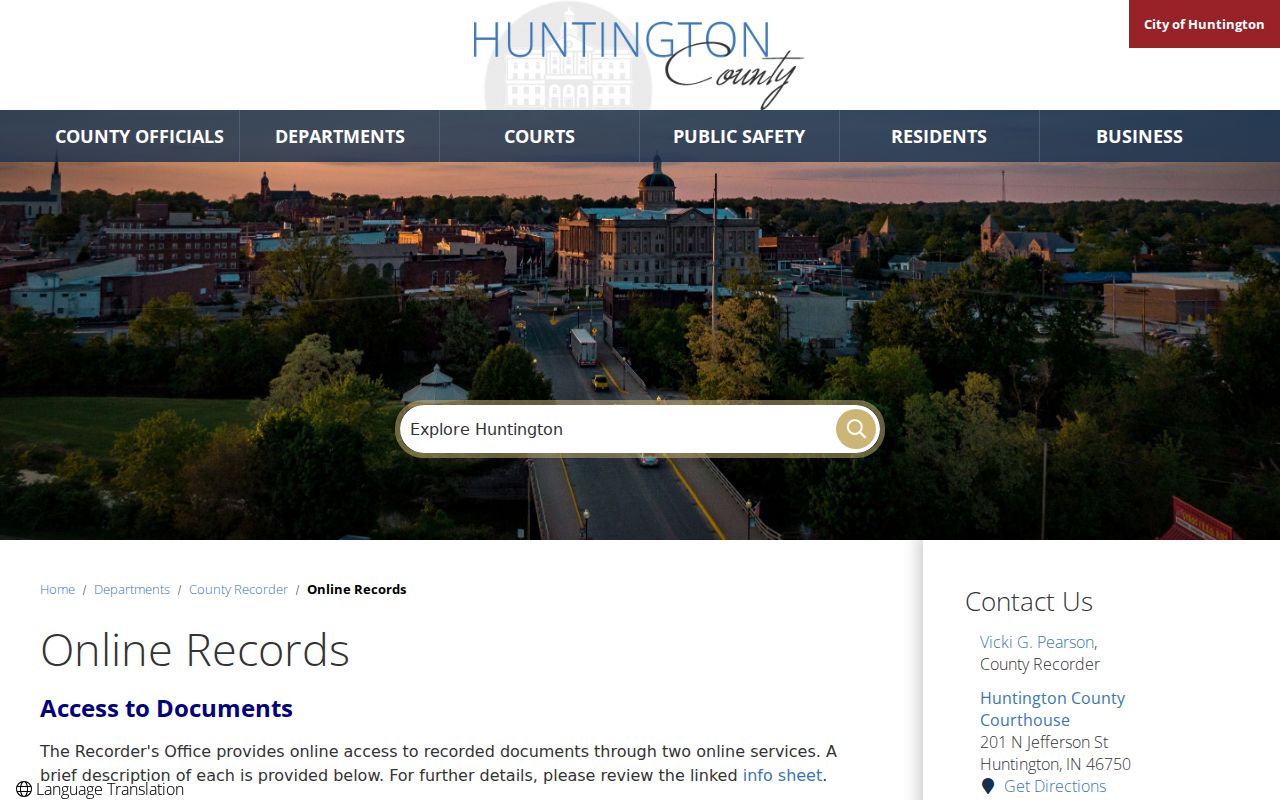
The official screen keeps both Fidlar access paths together. It names the Recorder as the public custodian behind each choice.
| Search control | How it narrows a deed | Useful entry |
|---|---|---|
| Grantor or grantee | Finds a transfer by party | Surname variants, initials, trust or entity style |
| Beginning and ending date | Limits a broad party search | An estimated transfer window |
| Legal description | Connects instruments to land | Subdivision, parcel ID, or metes-and-bounds words |
| Document type | Separates deeds from liens and releases | The instrument family being traced |
| Document number or book/page | Pulls a known record directly | The exact recorder reference |
Consideration can serve as a search parameter too. Treat it as an index clue. Nominal consideration, estate transfers, and other non-arm's-length deeds can differ from market price, and the portal's full document-type menu sits behind paid access.
Tapestry and Laredo Access
Tapestry suits a person who needs one Huntington County deed search. The county's Fidlar sheet lists $5.95 per search. It includes image viewing. Printing costs $1 per page. Laredo runs on a subscription for regular county-specific work. The public county page does not state its price. Both products are remote doors to the Recorder's index, not separate custodians. The courthouse still matters. Recorder Vicki G. Pearson's office sits in Room 101 at 201 N Jefferson Street, Huntington. Hours are 8:00 a.m. to 4:30 p.m. Monday through Friday. Call (260) 358-4848 before visiting if the goal involves old volumes or a terminal. A narrow request should include party names. Add a date range, legal description, and any known book/page or document number. Note: Recorder staff retrieve identified instruments but do not perform a lien search, interpret priority, or give a title opinion.
Walk Huntington's Grantor-Grantee Chain
Indiana organizes its deed indexes around the party who transfers land. The other side of each entry is the party who receives it. That structure pays off in Huntington County. A researcher can rebuild a chain even when a street address changed or never appeared. Start with the newest reliable owner clue. Hold the land description constant, and move one conveyance at a time.
- Use Beacon's Owner (Auditor) field as a starting clue, then find that party as grantee in the recorder index.
- Open the deed and copy its grantor, recording date, reference, and full legal description.
- Search that grantor as an earlier grantee. Compare the description so a same-name party does not send the chain to different land.
- Repeat backward. When remote coverage ends, continue through the office, deed books, or State Library microfilm guide.
- Grantor
- The party transferring an interest.
- Grantee
- The party receiving an interest.
- Chain of title
- The ordered sequence of conveyances tied to the same land.
- Book/page or document number
- The reference used to retrieve the recorded instrument.
Parcel numbers bridge Beacon and recorder records, yet older deeds lean on subdivision, lot and block, section-township-range, or metes-and-bounds language. A legal description outlasts any street label. The full backward-history method appears on the former owners page.
Huntington Deeds Back to 1834
The Indiana State Library microfilm finding aid gives Huntington County deed records a firm historical floor. General deed indexes divide into 1834-1867, 1867-1883, 1883-1896, and 1896-1902 runs. Deed Record Volume 1 covers 1834-1840, and later lettered and numbered volumes continue through the nineteenth century. That structure aids searching, not just local history. Pick the right index block, locate the party reference, then request the matching deed-book image. The county's Tract Book Volume 1 spans 1830-1853, reaching back across county formation. Early records often name a section or acreage rather than a modern street. Official accounts describe no courthouse fire or deed-book loss. The same sources do not say which old volumes have been scanned into Fidlar. Ask the Recorder whether a target volume is online, on an office terminal, or available only through a book or film. That keeps the chain grounded in documented coverage. Note: Huntington County was created in 1832, and its surviving land-book trail begins soon after the county seat was platted.
Huntington Property Fraud Alerts
The Recorder offers a free Property Fraud Alert. Registration can warn that a document matching a watched name has entered the public record. It does not prevent recording, judge a deed's validity, or replace review of the image. It simply gives an owner a prompt. The owner can then contact the Recorder when a filing looks unfamiliar.
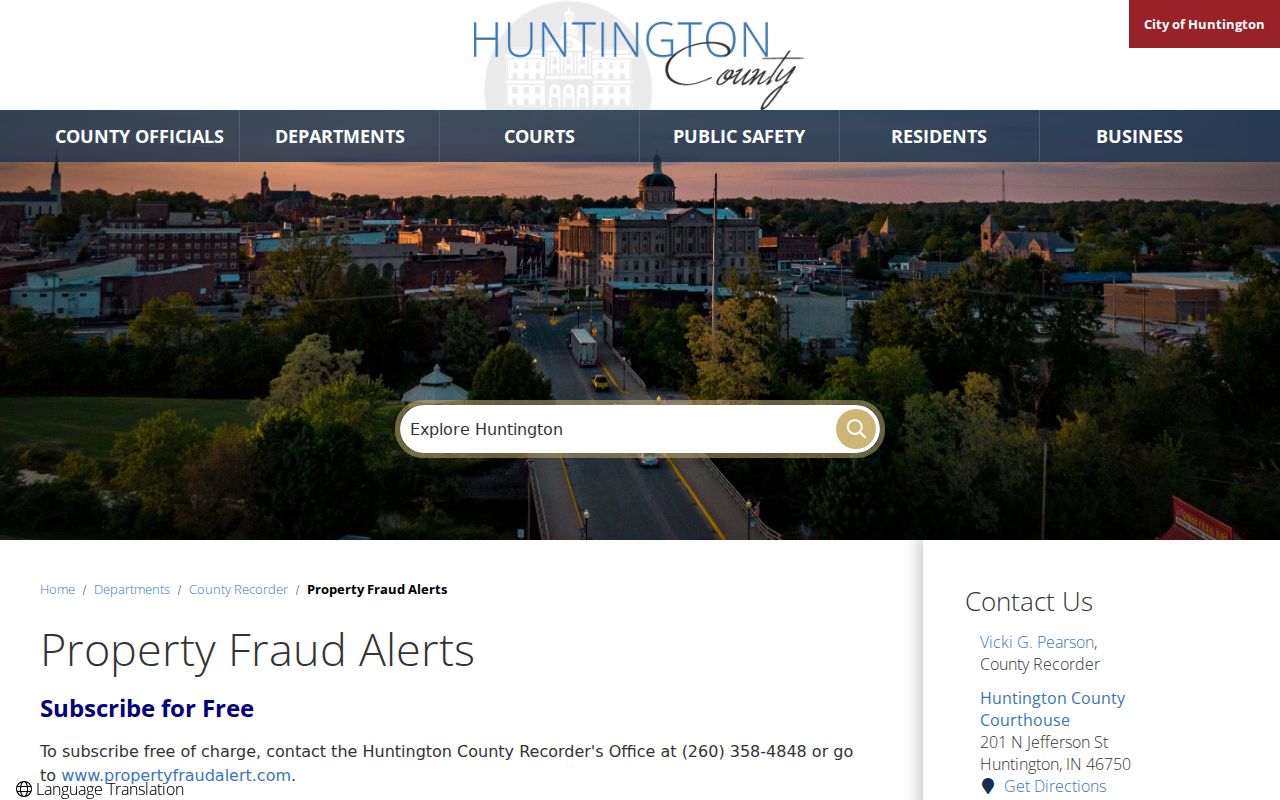
Huntington County frames its deed alert as an early-warning service. That means every hit still needs review. Confirm the match with the Recorder before acting on it.
One familiar scam sells a copy of a newly recorded deed at an inflated price. Huntington's Recorder points out that a deed is already a public record. An office copy often runs $2 or less. Check the solicitation against the Recorder's current fee schedule and contact details before you pay anything. The recorded instrument is what counts.
The alert earns its keep after a purchase, an estate transfer, or a change to a trust. Register several name styles so likely variants surface. Then verify each notice with the county office that holds the deed records.
Request a Huntington Deed Copy
Once you have a Huntington County deed reference, view it through the paid remote service. Or request it from the Recorder. Standard pages up to 11 by 17 inches are listed at $1 each. Larger pages are $5. Certification is $5 under the recorder fee framework. Recording costs run differently. A deed or other non-mortgage instrument is $25. A mortgage is $55. Confirm the amount before you pay.
At the counter, bring the book and page, the instrument number, party names. Bring an approximate recording date too. Cash, checks, and credit cards all work, though cards carry a convenience charge. For a mailed or APRA request, name the existing instrument. Ask for an itemized estimate. Inspection during regular agency hours is free under Indiana's Access to Public Records Act. Copies and certified records may carry the statutory fee.
When a deed sits inside a probate or court fight, the Clerk's case file may hold orders the recorder index cannot supply. MyCase gives the public a finding route, but the Clerk keeps the official file. For boundaries, read the deed description beside a recorded plat or survey. A tax map line is not proof.
Recorded, not guaranteed. Huntington County deed records show instruments accepted for recording. They do not resolve every unrecorded interest, defect, or priority question, and they are not a title opinion.
Plats Behind Huntington Deeds
Some Huntington County deeds only make sense next to the recorded plat. A lot-and-block description points to a named subdivision map. Rural land may use section-township-range or metes-and-bounds calls. The Recorder keeps plats and surveys. Countywide development staff review new lots, line moves, plat amendments, and plat vacations.
The State Library's Huntington County plat-book catalog covers the 2002, 2011, 2013, and 2024 editions. Those books add useful historic and geographic context for a property search. They never replace the recorded subdivision plat or the deed description itself.
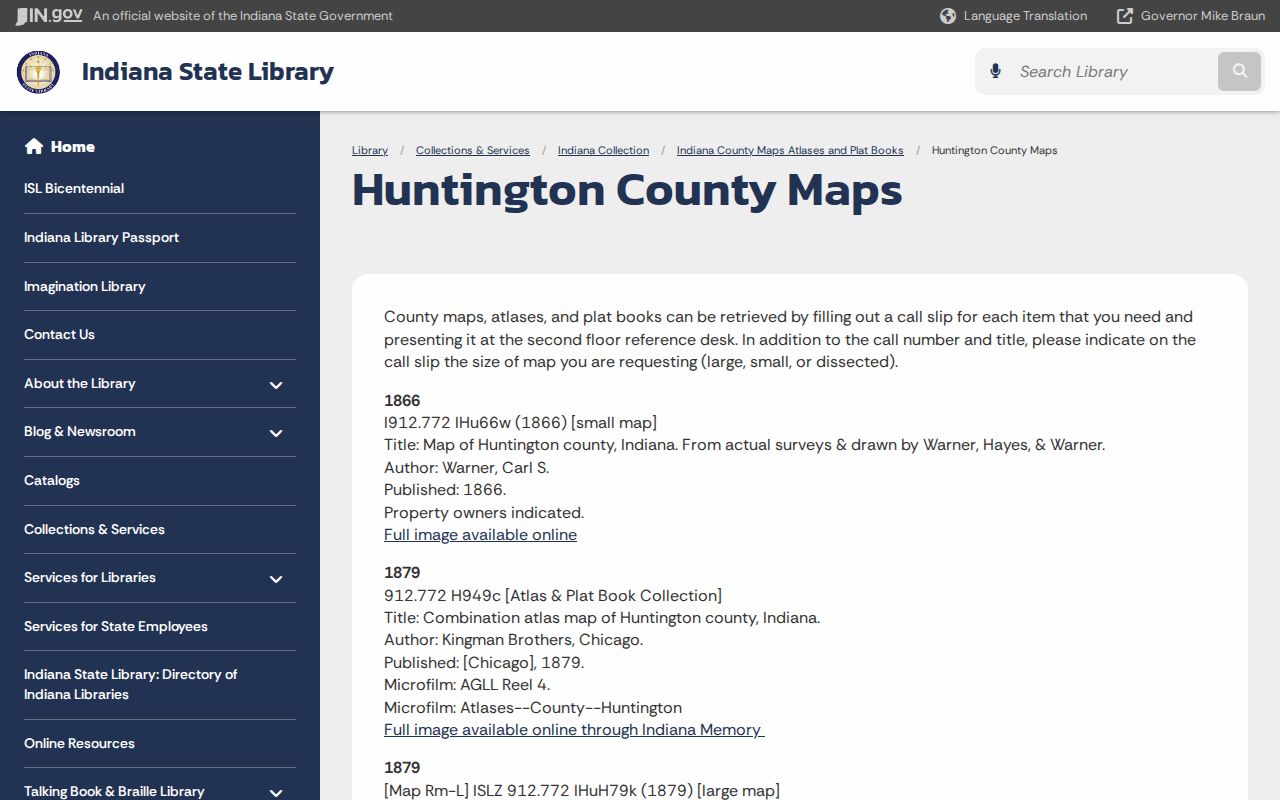
The catalog shows how published plat books form their own research channel. Use their names and map context to sharpen a records request. Then return to the Recorder for the controlling instrument.