
Compare Huntington County Value Types
Every value has a purpose, a date, and a keeper. A deed records a transfer. Huntington County's assessment record exists to support property taxation, and a licensed appraisal answers a market question as of a stated effective date.
| Value | What It Is | Where |
|---|---|---|
| Assessed value | Tax-system value under Indiana assessment rules | Assessor and Beacon |
| Market value-in-use | Indiana standard reflecting current use | Assessment framework and roll |
| Recorded consideration | Amount stated for a conveyance, which may be non-market | Recorder deed |
| Land and improvements | Separate site and structure components | Beacon modules when populated |
Indiana assesses at 100 percent of market value-in-use. That ratio is not a sale guarantee. Sale conditions, timing, deductions, property use, and the assessment date can all pull the figures apart.
Read Huntington Assessed Value Fields
The Huntington County Beacon report can display the PIN, Tax ID, owner, situs, class, acreage, neighborhood, district, land details, improvements, and legal description. Match each value module to its record year. The state's assessed-value explanation points to one figure. Total land plus total improvements is the number to find.
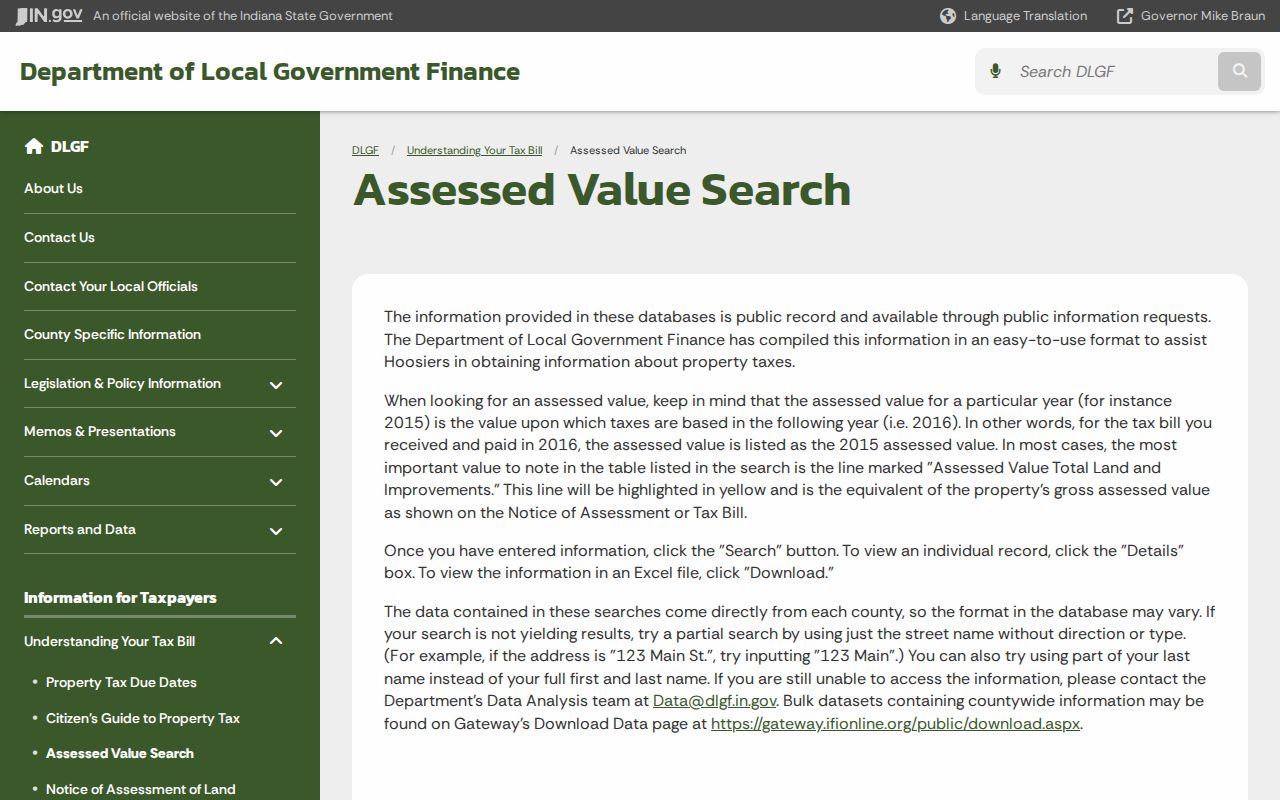
The state screen supplies the label. The Huntington County parcel record supplies the amount and year. A vacant class 100 parcel of 22.42 acres, for example, shows tillable and woodland soil rows. Its improvement, photo, and sketch modules sit blank. That pattern follows from the parcel class and its assessment data. It does not come from a hidden house.
Estimate Huntington County Record Value
Start with the right parcel and the right year. An address alone can mislead when rural situs text runs short or a parcel changed through a split.
- Search Beacon by address, owner, formatted PIN, or alternate Tax ID.
- Confirm situs, legal description, acreage, class, and district.
- Record the year and separate land from improvement amounts.
- Check the latest matching deed for consideration and transfer context.
- Assessed value
- The value carried for Indiana tax administration.
- Market value-in-use
- The state's value standard based on use.
- Assessment ratio
- The relationship between assessed and market value-in-use.
- Consideration
- The amount or value stated in a transfer.
- Reassessment
- A review that updates property facts and value.
Track Huntington Annual Value Changes
Indiana assessments trend annually inside the market value-in-use framework. So a parcel's assessed value can shift without any sale. Market evidence or corrected facts will do it. So will improvements, demolition, a change in use, or a split. When you compare, keep the parcel and the component identical across years, and never set land alone against land plus improvements. A tax district explains levy context, not market worth.
Follow Huntington's 2026 Reassessment
The Indiana DLGF cyclical reassessment starts July 1, 2026, for 2026 Pay 2027 taxes. It reviews 25 percent of parcels yearly over four years. Physical inspection and data correction can change value inputs. Watch the assessment year and the Form 11 notice. An older figure is not fixed. Cyclical reassessment remains mass appraisal work rather than a private opinion of sale value.
Compare Huntington Sale Consideration
The Recorder index can list consideration as a search field. A deed may state an amount. Neither figure must be arm's length. Family transfers, nominal consideration, estate deeds, and sheriff's deeds often sit outside the market. Match the legal description and the recording date. A modern PIN bridges current systems. An older deed leans on lot, block, or section terms. Consideration documents a transaction; it is not a fresh opinion of worth.
Separate Huntington Value From Deductions
The Auditor applies deductions and keeps the tax roll. The Assessor maintains characteristics and the assessed value. Those jobs are different. A deduction changes the taxable result, though, without touching the deed or proving a new market value. For bills, deductions, delinquency, or appeal steps, use the Huntington County property tax records page.
Limit Huntington County Value Conclusions
An assessed value is a mass-appraisal result for taxes. It promises no sale price. It sets no listing price, locates no boundary, and clears no title. Beacon itself warns that its public data changes and carries no accuracy warranty. Confirm parcel facts with the Assessor. Confirm transfer facts with the Recorder, and get a qualified appraisal with a clear date and scope when a current market opinion matters.
Value versus price. A Huntington County assessed value serves tax administration. It is not a sale forecast or a licensed appraisal.
Read Huntington Value Geography
Neighborhood and tax-district fields are context, never appraisals. A Warren mailing address can sit in Jefferson Township. ZIP codes and corporate limits follow different lines. Compare like uses inside the right assessment neighborhood before treating another parcel as a value reference. The 2026 DLGF land order names College Park Addition, City Park Addition, Roanoke Corp, and Villas of Roanoke among local assessment neighborhoods. Those labels organize year-specific analysis; they do not prove matching condition, improvements, access, or legal rights.
Request Huntington Assessment Records
If Beacon is unavailable, visit the Assessor. The office lists (260) 358-4800 and weekday hours of 8:00 a.m. to 4:30 p.m. in Courthouse Room 102 at 201 N Jefferson Street. Bring the PIN, address, assessment year, and the exact field you need. The Auditor handles roll and deduction questions. The Recorder holds the deeds. Indiana APRA covers existing records and free inspection during agency hours, though it does not require a new valuation study. Keep the year attached to every value.
Compare Huntington Changed Parcels
Splits and combinations can quietly distort a year-over-year comparison. A single old parcel may reappear as several assessments. Several may merge into one. When a recent change is hard to trace, the Treasurer suggests searching by the owner's last name. Gather both active and inactive PINs before adding anything up.
A jump in value often has a plain cause. Acreage shifted, the class changed, land type moved, or improvements were added or removed. Match the legal description and parcel status across the years you compare. Not every increase is market growth. Some are simply physical or administrative changes written into the property records.
Preserve Huntington Value Comparisons
A comparison is only as good as its labels. Keep the parcel report with its assessment year, PIN, legal description, and class. Save the acreage, land amount, improvement amount, and total assessed value with it. Retain any neighborhood label as well. Then note the deed's consideration and recording date on its own line. Rolling everything into one plain number erases the differences the records exist to show.
Rural vacant land deserves extra care. Soil and land-type rows may hold most of the assessed value. Meanwhile the improvement modules may sit empty. An improved in-town parcel can flip that mix entirely. Match the same use and value component. Do not settle for two totals pulled from nearby map shapes.
If a figure looks wrong, start with objective facts: acreage, class, structures, and parcel identity. Indiana DLGF lays out Form 130 routes for objective and subjective assessment issues. Those routes bring local review and possible PTABOA action. Those appeal mechanics live within property tax records. Yet they also explain why an assessment file can change later. A dated report saved beforehand shows the value as it was displayed. It preserves that figure before any correction or review.
Align Huntington Value Dates
Two accurate figures can still make a poor comparison if their dates differ. Keep the assessment date and tax year beside the assessed value. Keep the recording date beside deed consideration. If the parcel changed after either date, note that event first. A new structure, a demolition, a lot split, a combination, or a land-class change can shift the tax record. No ordinary market sale needs to take place.
Neighborhood factors belong to a stated year as well. The DLGF land-order material names local neighborhood classifications and year-specific factors. Even so, it cannot turn every nearby parcel into a comparable sale. College Park Addition, City Park Addition, Roanoke Corp, and Villas of Roanoke each reflect their own assessment context. Condition, acreage, access, improvements, use, and legal rights can still differ. That variation shows up within a single named area.
Build a clean Huntington County property value worksheet with separate columns. List source, value type, effective year or date, parcel status, land amount, improvement amount, and transfer context. That discipline keeps a mass-appraisal tax figure, recorded consideration, and a private appraisal apart. None of them collapses into one unsupported estimate.